
The most common type of laryngeal cancer originates from the cells lining the larynx (squamous cell carcinoma), while other types—such as sarcoma, melanoma, and other rare forms—account for no more than 2% of cases.
Warning Signs of Laryngeal Cancer:
A change in voice or hoarseness is a critical warning sign that requires attention, particularly among smokers and older adults. Although hoarseness can accompany common throat or laryngeal inflammation and recur with colds, it warrants medical examination and treatment. If the condition does not respond to standard medication within a short period (two to three weeks), it is essential to rule out the presence of masses or tumors in the larynx and vocal cords. Key symptoms reported by patients with laryngeal tumors or cancer include:- Hoarseness or a rough voice.
- Difficulty breathing, shortness of breath, or noisy breathing (wheezing/rattling).
- A sensation of tightness or choking in the throat.
- Appearance of a lump in the neck (enlarged lymph nodes).
- Coughing up blood.
- Coughing up blood.

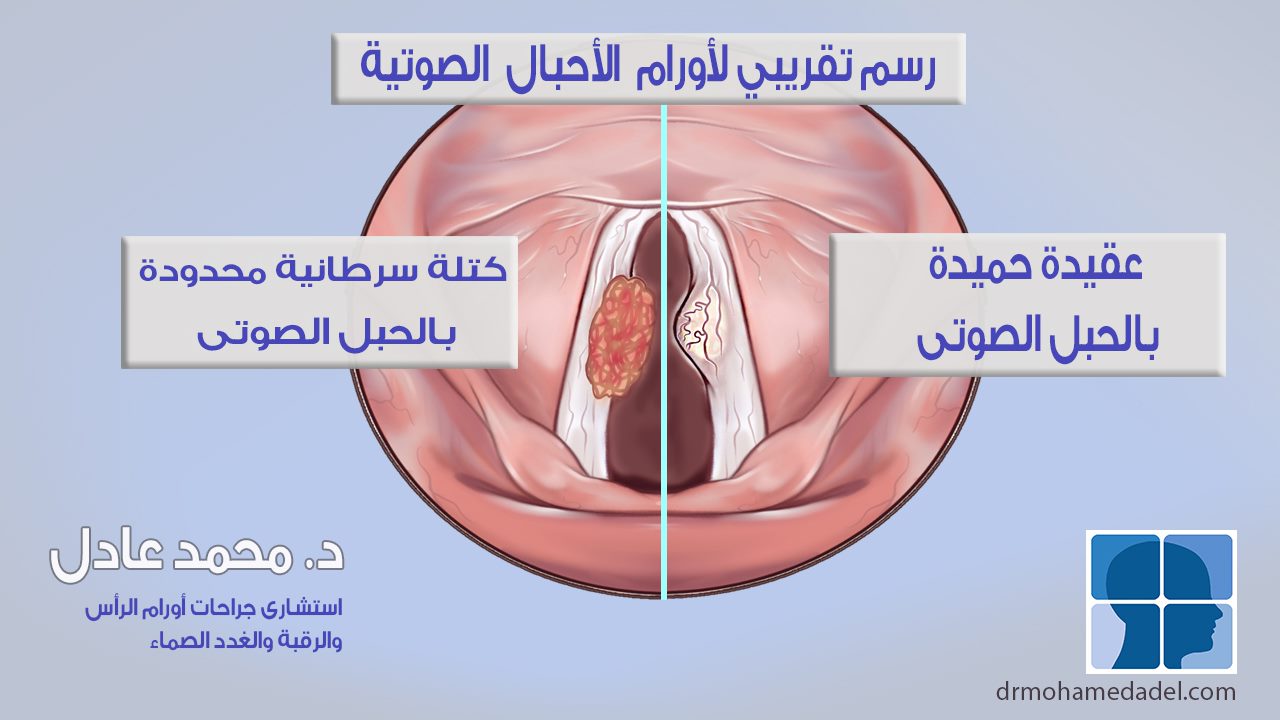

يعرض دكتور محمد عادل علامات سرطان الحنجرة فى هذا الفيديو
What are the types of vocal cord masses and polyps?
Many benign and cancerous conditions share similar symptoms during the early stages of the disease. However, a definitive diagnosis can only be reached through histological analysis—specifically by taking a biopsy of the mass—in cases where the tumor is suspected to be malignant. The larynx can develop various benign nodules and polyps; these typically present with mild, limited symptoms. In contrast, cancerous tumors are characterized by one or more of the following:- Failure to respond to simple treatments, with symptoms that do not improve over time.
- Potential association with difficulty swallowing or breathing.
- Presence of an enlarged mass in the neck (swollen lymph nodes).
- Higher incidence among older adults and smokers.
What are the risk factors for laryngeal cancer?
Several factors can contribute to the development of laryngeal cancer. Smoking is by far the most significant factor; others include:- Alcohol consumption
- Chronic acid reflux (GERD)
- Human Papillomavirus (HPV) infection
What are the complications of laryngeal cancer?
The stage of the tumor plays a crucial role in determining the treatment plan and the likelihood of recovery. Consequently, in the advanced stages of laryngeal cancer, the patient may experience the following complications:- Suffocation due to airway obstruction caused by a large tumor.
- Difficulty swallowing and weight loss resulting from the tumor pressing against the pharynx.
- Formation of an external skin fistula due to the tumor extending through the laryngeal cartilages.
Key medical advice and healthy habits for laryngeal and vocal cord health:
- Drinking water regularly and avoiding dehydration.
- Abstaining from smoking, using a hookah (shisha), and chewing khat or tumbak.
- Using the voice in moderation.
- Treating throat and pharyngeal congestion, as well as acid reflux.
Diagnosing laryngeal polyps and cancer:
Endoscopic examination is the most important test for a patient suspected of having a mass or tumor on the vocal cords. If the physician observes changes warranting a biopsy, the procedure is essential. However, if the examination reveals only inflammation or congestion, the patient is prescribed medication and health guidelines, followed by a later check-up.Imaging tests (such as CT and MRI scans) are also used to determine the tumor’s dimensions and its relationship to surrounding tissues.Treating laryngeal cancer
Following a diagnosis of laryngeal cancer, we assess the tumor’s local stage (its extent within the larynx and its relationship to laryngeal cartilages, tissues, and ligaments) and evaluate the spread of cancer cells throughout the body using nuclear medicine scans.
Based on this assessment, we determine the appropriate course of action for the patient, taking into account various health and functional factors and adhering to precise scientific standards. We may opt for:
- Complete tumor removal via microlaryngoscopy, or a partial laryngectomy with laryngeal reconstruction. In such cases, vocal function is often preserved, allowing for a gradual return to a natural voice, followed by periodic patient follow-up.
- In cases of advanced tumors—or where a response to chemotherapy or radiotherapy is not anticipated—we perform a total laryngectomy, creating a permanent breathing opening (stoma) in the neck. To compensate for the loss of the larynx, prosthetic devices are fitted immediately after the surgery.
- Radiotherapy and chemotherapy yield excellent results and cure rates in many early-stage cases, often allowing patients to preserve their voice and return to a normal life. Surgery to remove the larynx is avoided in these instances, and the patient undergoes periodic follow-up.
Services provided by Dr. Mohamed Adel for patients with laryngeal tumors:
Dr. Mohamed Adel is a surgeon specializing in head and neck tumor surgery. He trained at leading global cancer institutes and completed fellowships in Head and Neck Surgical Oncology and ENT surgery in Taiwan and India. There, he performed microsurgery, laser surgery, and advanced open surgical procedures under the supervision of renowned specialist surgeons. He was selected for recognition by the International Federation of Head and Neck Oncologic Societies (IFHNOS) in New York, USA. Dr. Mohamed Adel offers his expertise to patients with vocal cord tumors and laryngeal cancers in the following areas:- Evaluation of laryngeal and vocal cord tumors.
- Endoscopic vocal cord biopsies.
- Laser excision of vocal cord polyps and nodules.
- Removal of vocal cord growths, nodules, and tumors.
- Open surgical removal of laryngeal tumors.
- Total laryngectomy and neck lymph node dissection.
- Partial vocal cord resection with voice preservation.
- Laryngectomy with prosthetic voice restoration.
- Tracheostomy (creation of an airway opening).