Skin Tumors and Melanoma
Have you noticed a lump on your skin or a change that concerns you? Understanding the nature of this change is the first step toward appropriate treatment, rather than remaining caught in a cycle of worry and uncertainty.
With Dr. Mohamed Adel, Consultant in Surgical Oncology, Head and Neck Surgery, and Endocrine Surgery, you can have skin tumors of the head and neck evaluated and discuss skin cancer treatment options if a diagnosis confirms malignancy. Treatment focuses on tumor removal and, when necessary, tissue reconstruction.
Do not delay having your skin changes checked. Book a consultation with Dr. Mohamed Adel to understand the most appropriate next step for your condition.
What Types of Skin Tumors Require Specialized Diagnosis and Treatment?
Different types of skin cancer vary in their growth rates and potential to spread. Therefore, the first step in skin cancer treatment is identifying the type of tumor. The main types include:
- Basal Cell Carcinoma (BCC): The most common type of skin cancer. It usually grows slowly and rarely spreads to other parts of the body. However, treatment is necessary to prevent it from extending into and damaging deeper tissues.
- Squamous Cell Carcinoma (SCC): The second most common type. It can be more aggressive and may require intensive treatment depending on its location and whether nearby nerves are affected. It may grow slowly or rapidly and can spread in some cases.
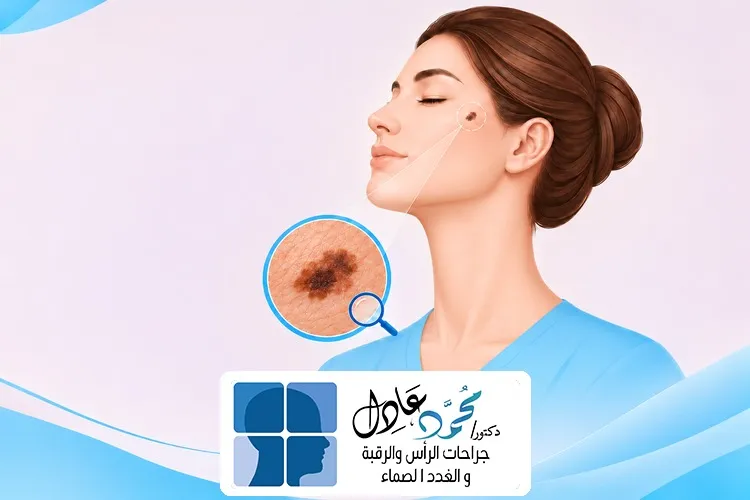
- Melanoma: Less common than the two types mentioned above, but more likely to grow and spread. It may develop within an existing mole or appear as a new spot that looks different from other moles. Early evaluation is essential to determine the appropriate melanoma treatment.
Image: Different types of skin cancer affecting the head and neck region
Different types of skin cancer in the head and neck region.
What Are the Risk Factors for Head and Neck Skin Cancer?
Factors that may increase the risk of developing skin cancer in the head and neck include:
- Frequent exposure to ultraviolet (UV) radiation from sunlight.
- Taking immunosuppressive medications.
- Previous radiation therapy to the head and neck region.
If you notice any changes in your skin, book a consultation with Dr. Mohamed Adel for an evaluation and to discuss the treatment options most suitable for your condition.
Scalp Tumors: When Do They Require Evaluation?
The scalp extends from the front of the head to the upper back of the neck and is generally covered with hair. It consists of five layers, beginning with the outer skin layer and extending down to the membrane covering the skull bones.
Due to the variety of tissues and cells in this area, several types of tumors can develop on the scalp. These include benign tumors, such as sebaceous cysts and nevi, as well as malignant tumors, including sarcomas. Most scalp tumors are benign, with malignant tumors accounting for approximately 1–2% of cases.
Some benign tumors may grow slowly and remain unnoticed or cause no symptoms for long periods. Malignant tumors, on the other hand, vary in their growth rates and potential to spread. Some may cause changes in surrounding tissues, ulceration, hair loss at the affected site, or bleeding. These changes require medical examination to determine their nature.
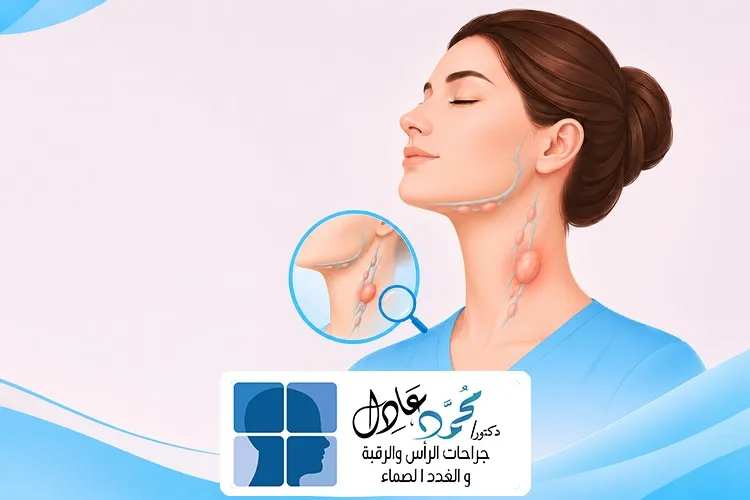
Enlarged lymph nodes in the neck may also be noticed. This requires evaluation to identify the underlying cause, but enlargement alone does not confirm that tumor cells have spread to the lymph nodes, as swelling may also result from infection or other conditions. You can learn more about the causes and methods of diagnosing and treating enlarged neck lymph nodes, and when further investigations may be necessary.
How Are Head and Neck Skin Tumors Diagnosed?
Evaluating your condition and identifying the type of tumor help determine the most appropriate skin cancer treatment. Dr. Mohamed Adel begins with a clinical examination and assessment of the skin changes, then determines which investigations are needed. These may include:
- Tumor biopsy: A tissue sample is taken and examined in the laboratory to determine the nature of the lesion.
- Imaging when necessary: To assess the tumor’s size and whether it has extended into surrounding tissues or the skull bones.
- Neck lymph node assessment: To determine whether further investigations are required.
Book a consultation with Dr. Mohamed Adel and bring your previous medical reports and investigations to discuss the results and understand the appropriate next step in your treatment.

Skin Cancer Treatment with Dr. Mohamed Adel
The skin cancer treatment plan varies according to the type, size, and location of the tumor, as well as how far it has spread. Surgery may be the primary treatment, while some cases may require additional therapies as part of a comprehensive treatment plan.
Dr. Mohamed Adel discusses your test results and the available options for tumor removal and reconstruction when necessary, helping you understand the details of your treatment before it begins.
When Is Surgical Removal of Skin Tumors Necessary?
Your doctor may recommend surgical removal after the diagnosis has been confirmed, with the aim of removing cancerous tissue and limiting its further spread.
The choice and extent of surgery depend on the type of cancer, its location and size, its characteristics, the risk of recurrence, and your overall health. Surgery is the most commonly used treatment for basal cell carcinoma and the primary treatment for most cases of melanoma.
What Are the Surgical Techniques Used for Skin Cancer and Melanoma Removal?
Your doctor selects the most appropriate surgical technique based on your condition, taking into account the need to remove the tumor while preserving as much healthy tissue as possible. Available options include:
Excision with Appropriate Safety Margins
The tumor is removed along with a margin of surrounding healthy skin. The excised tissue is then examined in the laboratory to assess the surgical margins and determine whether cancer cells are present.
Depending on the results, additional tissue removal may be necessary. Therefore, clear margins cannot be confirmed until the tissue has been examined.
Mohs Surgery for Skin Cancer
Mohs surgery involves removing thin layers of tissue and examining each layer under a microscope. The process is repeated until the examined tissue is free of cancer cells.
This technique is suitable for selected cases, particularly when there is a higher risk of recurrence or when preserving healthy skin is especially important, such as in areas around the eyes, nose, and ears.
Do You Need Additional Treatment After Tumor Removal?
Melanoma treatment may involve examining nearby lymph nodes or taking a biopsy to determine whether the tumor has spread. However, involvement of a lymph node does not automatically mean that all lymph nodes must be removed, as monitoring may be sufficient in some cases.
Depending on your condition, additional treatment may be required, such as immunotherapy, targeted therapy, or radiation therapy. Dr. Mohamed Adel explains your test results and the appropriate steps needed to complete your treatment plan.
What Are the Possible Complications and Recovery Instructions After Surgical Skin Cancer Treatment?
Your recovery period varies depending on the size and location of the excision and whether you require a skin graft or reconstructive surgery, particularly in cases that need reconstructive surgery following tumor removal to restore appearance and function as much as possible.
For this reason, post-operative instructions are tailored to your individual condition. General guidelines include:
- Possible complications: Temporary pain, swelling, and bruising may occur, along with the possibility of bleeding, wound infection, numbness, or scarring. These effects vary depending on the procedure.
- Wound care: Follow the instructions for cleaning the wound, changing dressings, and taking prescribed medications. Avoid strenuous activity until your doctor advises that it is safe to resume.
- When to contact your medical team: Seek medical advice if you develop a fever, increasing redness, swelling or pain, pus discharge, wound separation, or bleeding that does not stop with direct pressure.
- Post-operative follow-up: Attend follow-up appointments to monitor wound healing and review the pathology results. These results may indicate whether additional steps are needed in your skin cancer treatment.
Discuss your expected recovery with Dr. Mohamed Adel, and ask about wound care and follow-up appointments so you can gradually return to your daily activities according to his instructions.
What Services Does Dr. Mohamed Adel Provide for Skin Cancer and Melanoma Treatment?
Dr. Mohamed Adel’s clinics provide diagnostic and surgical services, along with therapeutic care coordinated by the medical team according to each patient’s needs. Dr. Mohamed Adel is a Consultant in Surgical Oncology, Head and Neck Surgery, and Endocrine Surgery.
Diagnostic Services
With Dr. Mohamed Adel, the process begins by identifying the nature of the tumor and discussing the investigations appropriate for your condition. This helps you understand your results and the available skin cancer treatment options.
Our diagnostic services include:
- Diagnosis of skin tumors of the head and neck.
- Biopsies of skin tumors in the head and neck region.
- Ultrasound-guided biopsies of neck lymph nodes.
Surgical Services
If surgery is required, Dr. Mohamed Adel draws on his experience in tumor removal and reconstructive surgery to provide appropriate treatment. The approach focuses on removing the tumor while preserving healthy tissue, function, and appearance as much as possible.
Surgical services include:
- Surgical removal of skin tumors.
- Reconstruction following removal of advanced tumors.
- Mohs surgery for precise, layer-by-layer removal of skin cancers in suitable cases.
- Removal of neck lymph nodes when necessary.
Therapeutic Services and Supportive Care
Under the supervision of Dr. Mohamed Adel, the medical team provides:
- Laser treatments for superficial benign tumors and vascular birthmarks.
- Interventional radiology and arterial catheterization for embolization of advanced vascular skin tumors.
- Support sessions and support groups for cancer patients and survivors.
- Radiation therapy and other cancer treatments as part of the treatment plan when indicated.
Thinking about treatment can be overwhelming, but understanding your options can help you feel more prepared. Book a consultation with Dr. Mohamed Adel to discuss your investigations, skin cancer treatment options, and whether tumor removal or reconstructive surgery may be necessary.
Frequently Asked Questions
Can Melanoma Be Completely Removed?
Yes. Melanoma can be completely removed in many early-stage cases. Treatment involves removing the tumor with appropriate safety margins and examining the excised tissue. More advanced cases may require additional treatments.
Does Skin Tumor Removal Surgery Leave a Scar?
Yes. Surgery usually leaves a scar, the appearance of which varies depending on the size and location of the excision. In many cases, the scar becomes less noticeable over time.
Dr. Mohamed Adel uses his experience in skin tumor removal and reconstructive surgery to select the most appropriate wound-closure technique, while preserving healthy tissue and appearance as much as possible.
Can Skin Cancer Return After Surgical Removal?
Yes. Skin cancer may recur in some cases, and the risk varies depending on the tumor type, stage, and characteristics. Therefore, follow-up remains important after skin cancer treatment. Additional therapy may also be recommended to reduce the risk of recurrence.